
08. The Interview: Amanda Busick
FOX Sports Broadcaster: NASCAR, NHRA

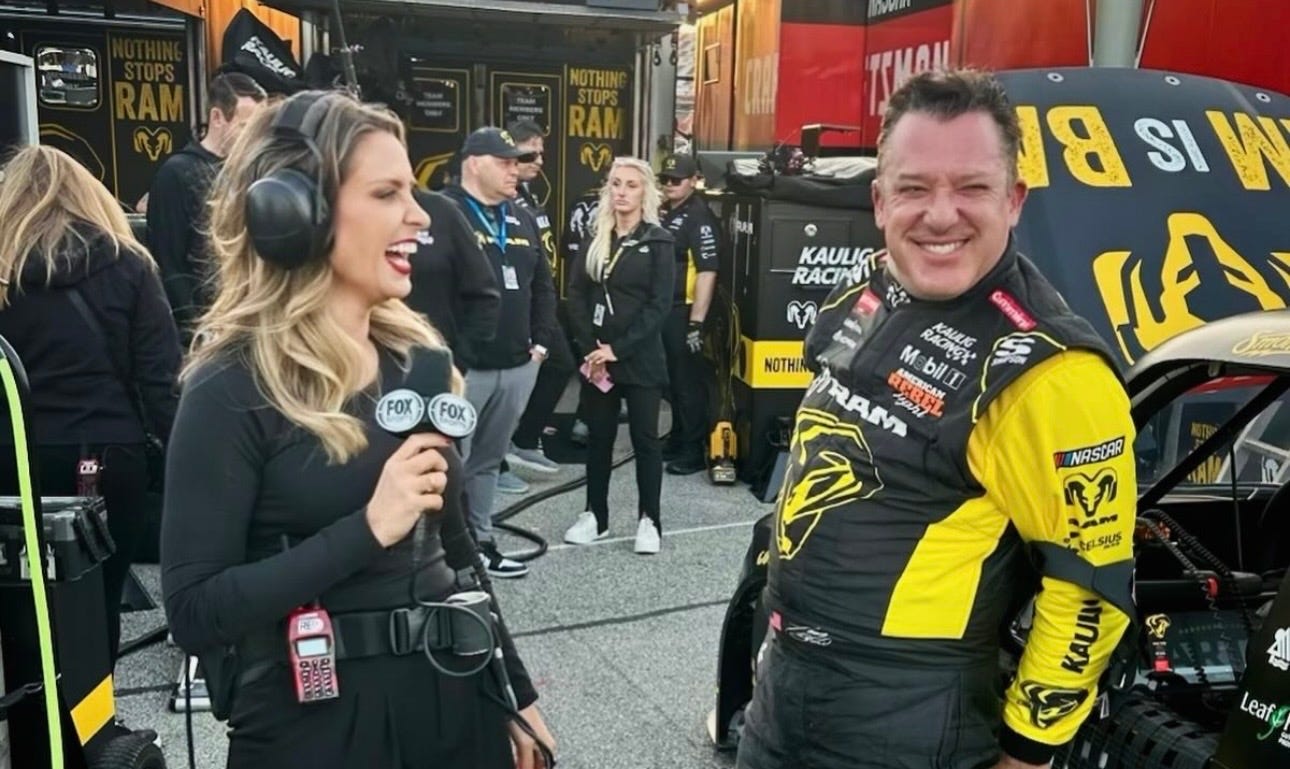
If you watch multiple forms of motorsports, there’s a good chance you’ve seen Amanda Busick, one of the most versatile reporters in the space. Inspired by the anchors she watched on morning news programs as a young girl, Busick has climbed to the top levels of broadcasting through sheer determination, willpower, and a commitment to always bet on herself first. From the Rolex 24 to NASCAR, and the NHRA, Busick has built a diverse portfolio of racing coverage to call her own.
KAITLYN VINCIE: When you were a little girl, I read that you enjoyed watching the local morning news. So where did your love of storytelling come from?
AMANDA BUSICK: I think it definitely started there. It was really kind of a ritual in our household to watch the news on WFMY-2 in Greensboro. My mom worked in construction, so she always had the news on to stay up to date on information and the weather. That was in the mornings, when we would have breakfast, then head to school while my mom would go to her job site. So that was a big part of my connection to the media. I looked up to the anchor Sandra Hughes. I remember seeing her at Party City one time when I was twelve years old, and I went up and introduced myself—I was quite literally obsessed.
KV: It’s funny because my parents said I would “do the local news” when I was little too, using a home camcorder. Your path in sports journalism has been hard-fought. What were the early days like in New York as an intern at a sports agency while also working at a steakhouse?
It really did start with struggle. I did go on to intern at WFMY-2 in the sports department under Greg Kerr—the same station I grew up watching. But I graduated right in the middle of the recession, and I almost have that crisis to thank, in a way, for this career. Because if that hadn’t been happening, I probably would have stayed in North Carolina. I was working for the state of North Carolina in the Department of Education, and when the state budgets were reduced, so was my job. I had worked at Sullivan’s Steakhouse in college, and I remember calling our general manager to ask if he could help me get a job at Del Frisco’s. I remember him laughing a bit and reminding me that it’s the top-grossing steakhouse in the world. Sure enough, I drove eight hours to New York City, met with the general manager, and he told me I would be starting in two weeks. Believe it or not, training to be a server in that restaurant was harder than probably any college exam I ever took. There were a lot of expectations—the formality of presentation and perfection. In a way, it’s like being on-air, which I had never thought of before. You perform with high expectations, and as reporters, you don’t get a redo. But for me, I’ve always had this unrelenting drive that is rooted in ambition and achievement.
KV: Fast forward to one of your biggest breaks—it was with the NHRA. How did you essentially audition yourself for them?
When I lived in Chicago, I was working multiple jobs. One was as a production assistant for Campus Insiders, another as a stage manager on the road for ESPN, and I also bartended at a place called Bub City. I loved it because their big nights were Wednesday and Thursday, so I could work there during the week and then travel for ESPN on the weekends. You know how it goes when you have to piece things together with multiple jobs. Then I ended up moving to Boston to work at Carando, an Italian meat company based in the Northeast and a subsidiary of Smithfield. Through that role, I met a lot of people connected to the Big Ten Network while booking appearances—whether it was Seth Davis, Bonnie Bernstein, or Jerry Palm. Around that same time, I heard that the NHRA was moving from ESPN to FOX. The opportunity was kind of floated to me, and it was full-time. I just went after it full tilt. I flew to Dallas, put together two packages, and delivered them to their media communications department. By the end of that weekend, they invited me to host the red carpet at their awards banquet. I was 28 years old, getting to host this event in November at the Kodak Theatre in Hollywood. They ended up offering me the job that night. I literally moved from Boston on January 2nd with three oversized suitcases to a corporate apartment in L.A. to get my career going with the NHRA. At first, I was hired as a digital reporter. Then, one fateful rainy weekend in New Hampshire, we had a rainout. On Monday, our reporter had to leave, so they put me at the top end. The following season, I was in that position full-time. Those kinds of moments come from being in the right place at the right time—but I always try to say yes to everything. Being present when opportunity presents itself has really been the theme of my career.
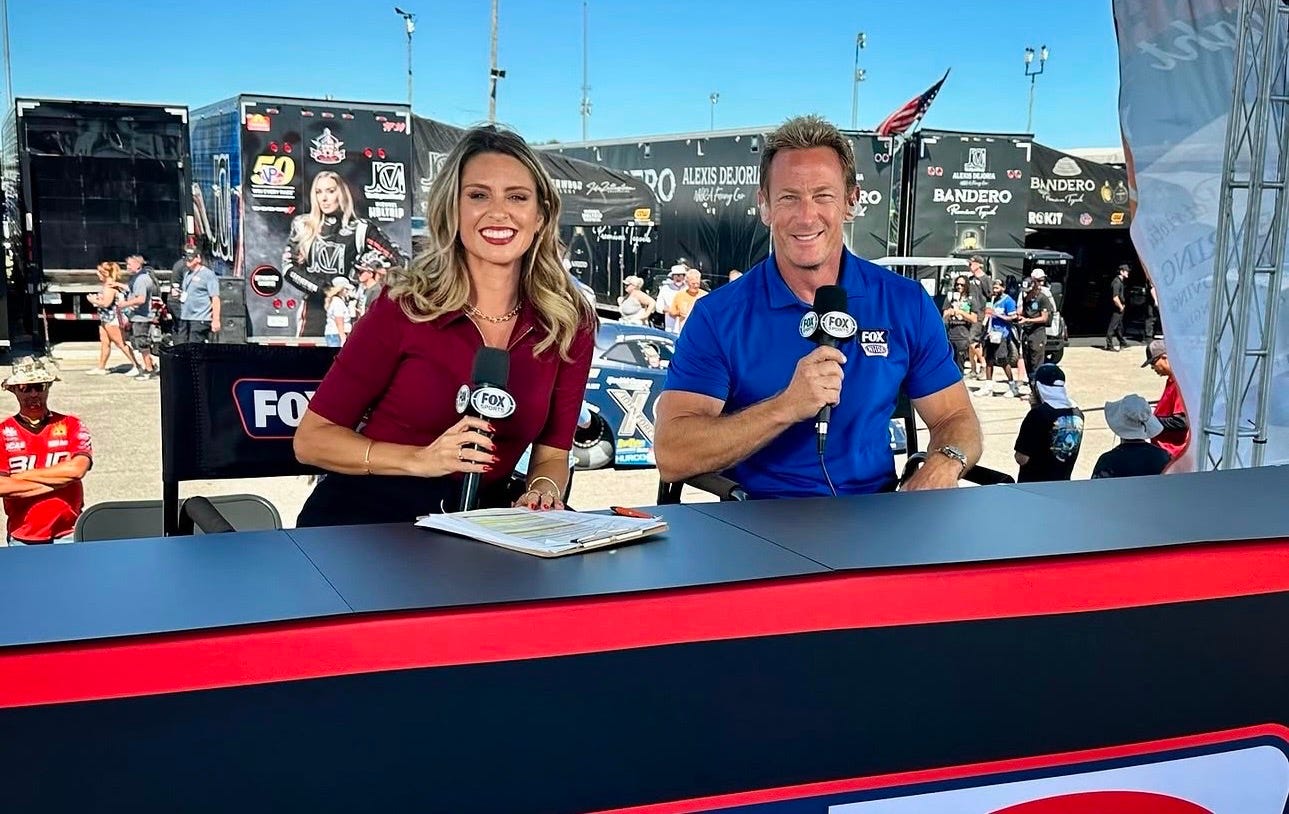
KV: I think there’s a lot to that—no one is going to advocate harder for you than yourself. You’ve been with the NHRA for many years now. What do you love most about that community in motorsports?
People and fans always ask me what my favorite gig is, and it’s impossible to pick because there are so many things I enjoy about all of them. But for me, NHRA will always feel like my firstborn. It’s where I got to cut my teeth, make mistakes, and grow. This is my eleventh season, and I’ve watched not only myself but the drivers grow up. I know their highs and their lows. I know what’s happened to them not only professionally, but personally. At this point, I have a sense of pride knowing I’ve been able to be with a sport for that long. To be a part of a sport for a decade has had a big impact on me—and hopefully on the fans too.
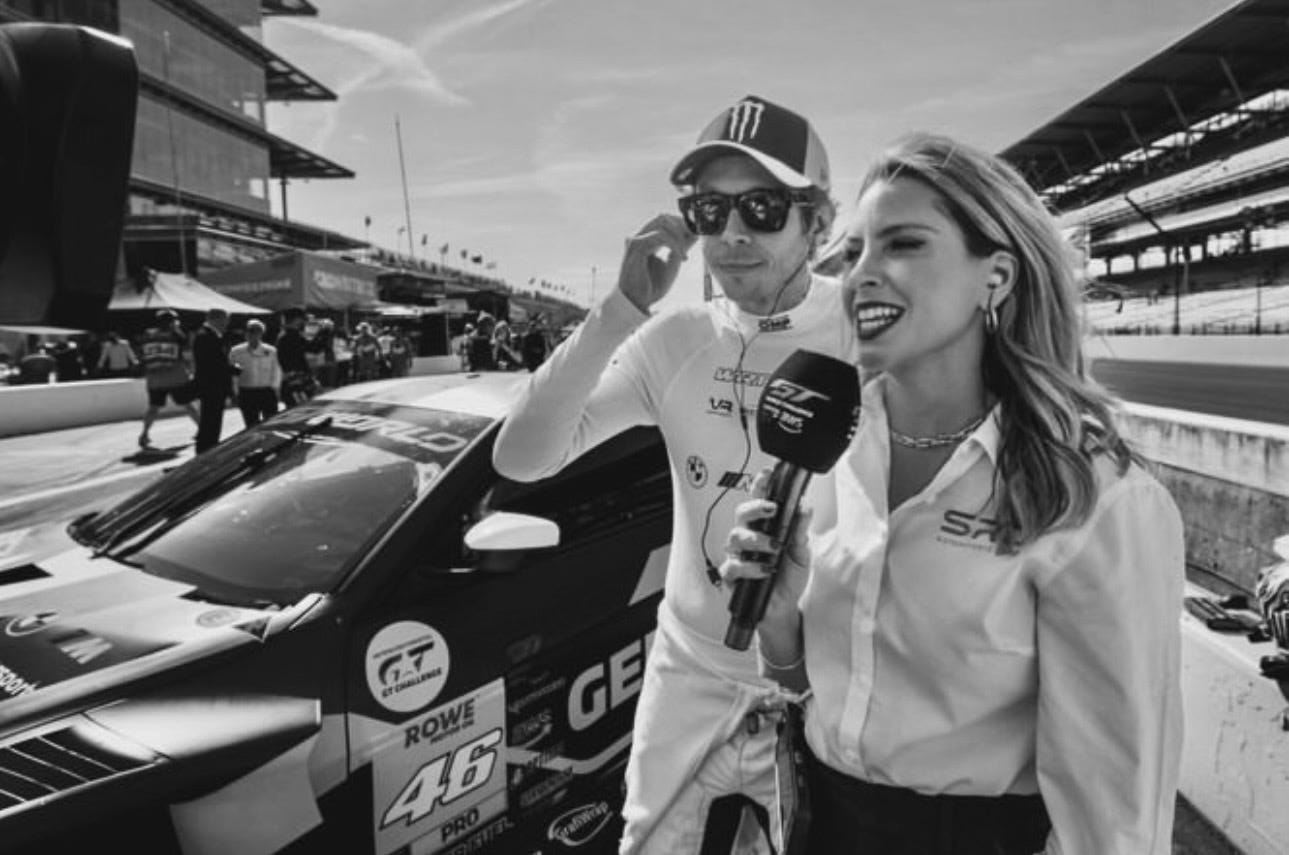
KV: I always joke with you that you’re one of the busiest women in motorsports—covering drag racing, NASCAR, sports cars, pretty much anything with wheels. How do you keep it all straight?
The way my brain works is that I overconsume information. Even if 87 percent of it I never use, you never know when you might need it. For all the series, I have alerts set—on six different series, most drivers, team news—so information is always coming in the background. I feel like as you spend multiple seasons within a series, you’re just adding onto the foundation you’ve already built. The most challenging one for me was when I started with SRO in 2021. I remember showing up in Sonoma, and there were probably 120 different entries across five different series, with multiple classes within each. On top of that, it was still COVID protocol, so everyone was wearing a mask. I was learning people by their eyes. Then at the next race, masks were no longer mandated, so it felt like I was meeting entirely new people again. Six years later, when a new driver comes in, I’m fine—I’ve got it. I already have the other 120 handled, so welcome aboard.
KV: That is a huge undertaking. Then this year, you got to serve as a reporter for your first Rolex 24. What was that experience like as a longtime motorsports journalist?
Pinch-me, right? And for multiple reasons. My colleague Calvin Fish recommended me for the job, and I’ve worked with him the last five years on SRO. I feel like I’m at a point in my career where your work starts speaking for itself. Early in your career, people are taking a gamble on you, and you have to prove yourself. To come in with a recommendation from someone so highly respected—I loved the pressure of knowing, “Well, you definitely can’t mess this up.” Getting a call from someone in the industry saying you’ve been recommended for a job—that’s a different level of validation.
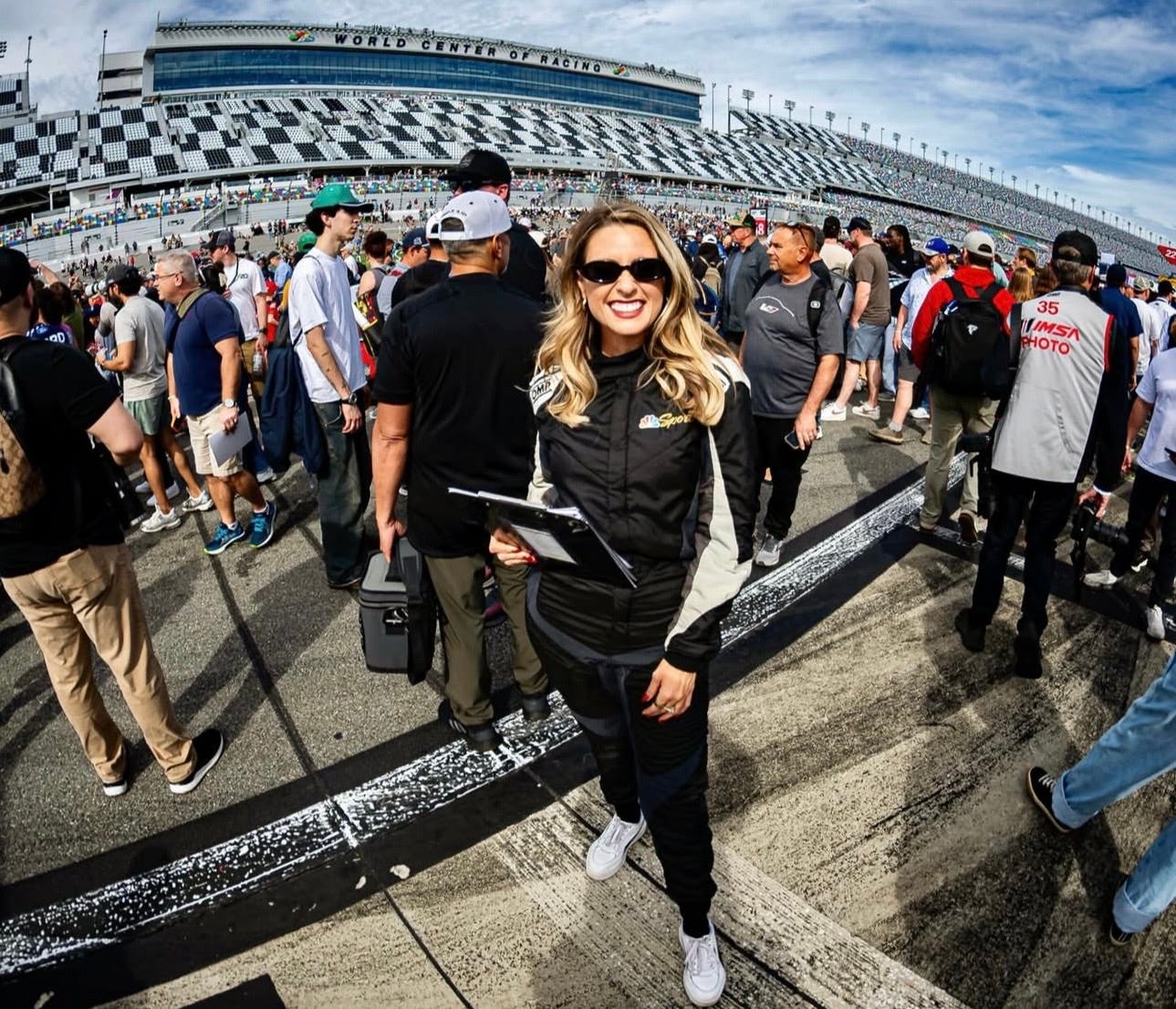
KV: After that race, I loved what you posted on Instagram about remembering people on the way to success. How have you carried that mantra throughout your career?
I will talk to every single person who reaches out to me, whether it’s on LinkedIn or social media. I did the same thing—there were so many people I reached out to, and the number of individuals who took the time to extend their support was huge. One of my biggest mentors and supporters was Jon Sciambi, who is now the voice of the Cubs. We would meet at a diner in New York City called Big Daddy’s, and he would point at the TV and ask me, “Who is that reporter? What sport do they cover? Why are they covering it?” He held me to a standard and poured his knowledge and skill into me, so it’s only right that I do the same for the next person.


KV: This leads me to your work with the Women With Drive Summit, which has allowed you to build a relationship with Lyn St. James, an icon in our sport. What’s it been like having her in your corner?
Just last year, after the championship race in Phoenix, I sat on Lyn’s patio and had lunch that she made for me. The idea that I get to walk into her home is incredible—and what you see is exactly who she is. She is a fierce supporter of women in motorsports. To stand alongside her and represent her vision through the summit—it’s never lost on me that I get to do that. To be in her presence and see how many people honor and respect the path she’s been on and what she continues to do—I’m a spectator in that moment.


KV: You’ve been part of so many motorsports events, but what’s still on your bucket list to cover?
I would say Le Mans is at the top of the list. Of course, the Indy 500 as well—being in American motorsports, that’s an absolute bucket-list item. Someone recently asked me what I wanted to do next, and I realized that doing something “next” might mean leaving what I’m doing now. At this stage of my career, it’s really about the people. I want to enjoy every moment of that. There’s so much grind and hustle when you’re building your career that sometimes you forget things will eventually end. I try to slow down, be present, and enjoy every part of it—make those memories. We’re lucky to live this life. I’m so grateful for the bonds we’ve formed, and I always look forward to that post-race dinner or conversation. It all becomes part of what this life is like—on track and off.