01. The Interview: Michael Verlatti
Vice President of the Signature Experience Group at NASCAR

The fan experience at every racetrack is one of the most unique elements that sets
NASCAR apart from other traveling professional sports. Michael Verlatti, the Vice President of the Signature Experience Group at NASCAR is redefining how fans experience NASCAR races.
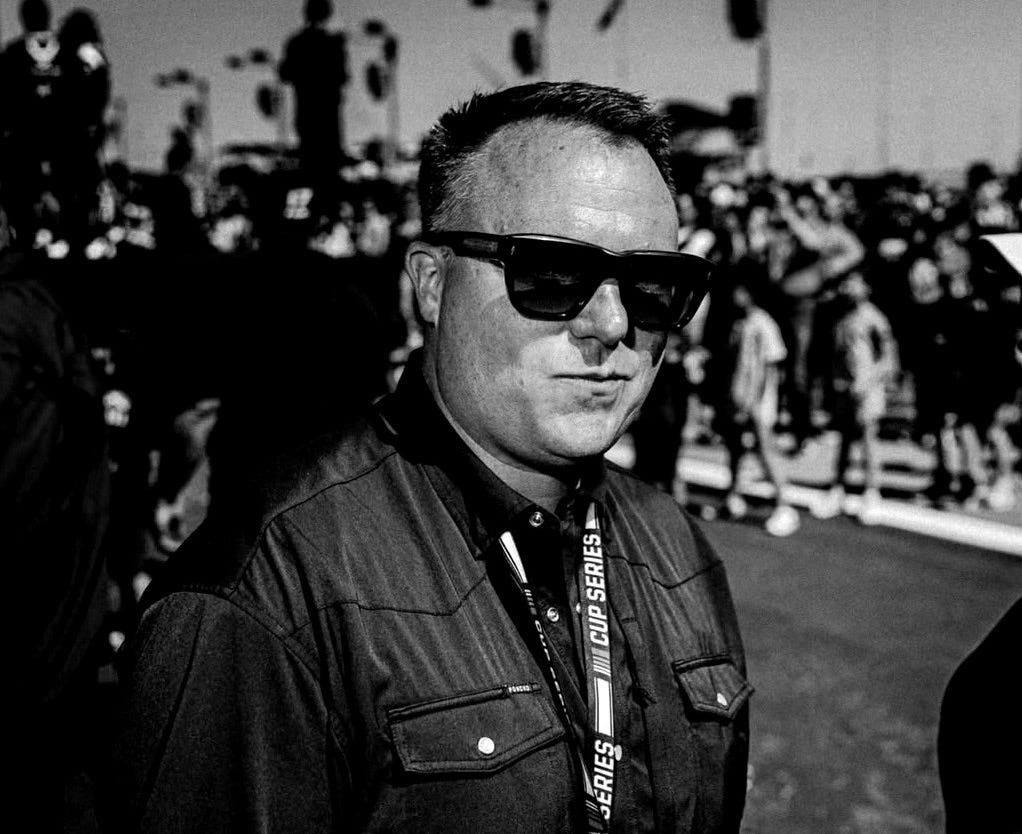
KAITLYN VINCIE: I know you have said “live event racing has been my life’s work,” and you were drawn to this type of career field from an 8th grade Christmas play, Christ the King. Tell me about this moment and how it set the stage for your life work?
For the Christmas play, I was put on a production team and those type of production elements came really quick to me, lighting calls, sound calls, microphones. I can see those things in my head without ever needing to look at it on paper. I can literally rehearse it in my head, and it comes to life pretty quickly in the field. It’s always been a talent that I’ve had. When I think back to ‘where did some of this start?’ I do attribute a lot to the Christ the King Christmas play. At that point, the teacher called me out, and was like, “you know all of this stuff top to bottom.” And I think from then on, I really continued to search out production opportunities.
KV: That’s so fascinating, because I was doing the news when I was eight-years-old with a home recorder.
See? That’s the interesting way that life goes. A little simple moment like that — turns into something.
KV: Then you drove the pace car when you were 16-years-old. How did you first get into racing specifically?
My Dad was a NASCAR Winston West official. That started in 1978 and he worked for NASCAR for 31-years and ended up taking a full-time position with them. He was the Southwest Series and the Winston West Series Race Director. I’m one of three boys in the house and my mom didn’t want to raise all three of us on her own, because my dad was gone every weekend. So, I started going to the track with him really, really young.
At age ten, I was sneaking into the pits and I would camp out in the racing radios trailer all weekend long, which would be my home base until the end of the race. At age 15, in 1994, I started working for the Southwest Tour as an official and I pretty much did every job that an official would do, inspections, pit road inspector. The racing radios guy was also the pace car driver at the time, so I would sneak into the backseat of the pace car and ride there, my entire childhood. And then when I was old enough to be an official and get my license, I started driving the pace car.
That’s also how I met Steve O’Donnell. He was in the series marketing department at the time. I was an official at the time, and he just kept hearing my name on the radio. And he went to my dad and was like, ‘who is this guy?’ And they introduced us. And I became friends with Steve, I kind of became his gopher. I would go get things for him and do things for him at the racetrack. And in 1998 they had someone call in sick in the series marketing department who couldn’t make it to Sears Point Raceway. So they called me and asked me to fill in as the Cup Series pre-race and post-race guy. And that was kind of the start of me working with them more consistently.
KV: That’s such a neat story. I would have never known you were once an official.
It really helps now with the officiating staff, because you better understand how they operate. You have to come up through those ranks.
I’ve looked through all the different positions you have held at Petty Racing, JHE, ISM to now Vice President, Signature Experience Group at NASCAR since 2022. For fans who don’t know what that means, explain what your job is?
I describe it as we run the things that guests see and hear from when they first walk in the facility, until they leave the facility. Everything except the competition. So that includes the fan zone, pre-race activities, food and beverage operations, hospitality, post-race ceremonies. Really all of the things that are entertainment based.
That is a very large undertaking. I know hospitality is a huge part of what you do. Why is it so important and how does it directly affect the fan experience?
How a fan’s favorite driver performs on the racetrack is totally out of our control, but what we can control is everything outside of that. So, if we can make sure that the guest has a really amazing and hospitable experience and leaves with a positive impression of the facility and the sport, we have done our job. I think it’s the most important event weekend activity that we control. I think that as we’re continuing to invest in that area of the business, we are trying to better understand what’s important for all of the different segments of guests, and then doing our part to make sure it doesn’t disappoint in any area.
KV: You all definitely don’t disappoint, it’s pretty impressive what your team does week to week. I’m curious, what all goes into designing the stage sets, where do you come up with how that’s going to look for the year?
We have been working fairly exclusively with Wasserman since the 2000 era. The way that it’s currently working is, I will sit down with their graphic designers and we start to draw different stages, sets, signage, and then we work through all of the different elements of what we’re trying to achieve on a race weekend. Like San Diego, we know that we have a 60 by 60 footprint and trying to determine what we want to do on that footprint. So, we looked at some inspiration from what we have done at the Daytona 500 in the past. We looked at Mexico, because Mexico was a non-traditional environment from a staging perspective and we’re probably going to emulate something close to that. Then we just start sketching. We get the sketch tightened up, and then put it into a graphic design software, which makes it look more realistic. That way we can bring it to partners and tell them how their brand will come to life.
KV: That’s the element of the stages. In connection with the stages, a lot of people are interested in being on-camera as a host or reporter. You obviously work with many of them throughout the season. How do you go about selecting talent? What are you looking for?
I’m constantly paying attention to other sports and entertainers in different fields. I’m attending a lot of events, just trying to see what they’re doing and then see if there’s a parallel that works in our world. The people that do come out, they’ve reached out or they’ve made an introduction one way or another. And then I start paying attention to the things that they’re doing. I look a lot at their social and I look at it over time. What type of content creator are they? It doesn’t mean they need to be the wackiest person on the face of the Earth, but if they’re trying to be a reporter and they’re presenting consistent content that’s buttoned up and great on the storytelling aspect, then I start to think about them in that way. I just try to give it a long runway in order to pay attention to their strengths and weaknesses. We’re currently trying to do that as we build out our entertainment team. We’re trying to make sure that we have a well-rounded team.
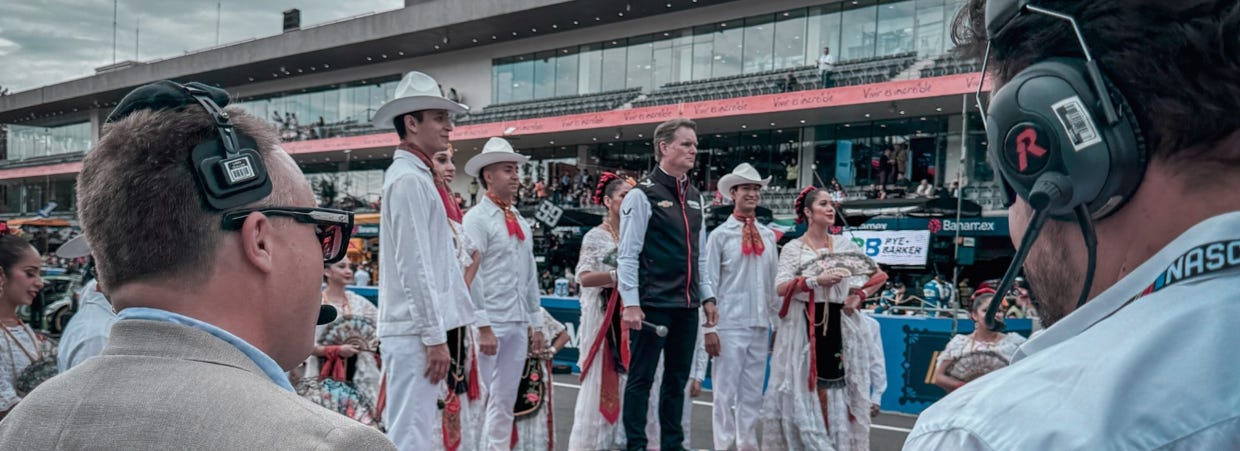
KV: You mentioned it a moment ago, racing internationally in Mexico. What are you most proud of from that marquee race weekend?
I’m really proud of the relationship we created with the team at OCESA. When we first started talking to them, I went to the Formula 1 race and watched what they did, and I knew that the bones of their presentation were solid. I think for me, I wanted to make sure I didn’t overstep because they are the promoter. It’s their responsibility, yet they also could learn a lot from what we’re doing on a consistent basis. By the end of the weekend we were in lockstep, and we created a really great relationship. So, we were able to bring in some of that Mexico culture into the event, while also definitely presenting an authentic NASCAR product to the guests in Mexico. We tried to make sure there was a balance. We had 25 dancers on stage, all in traditional Mexican dress. It was fun, we rehearsed it, we practiced. We had little different things we did for Joey Logano as the reigning Champion, we did something special for Daniel Suarez, but we tried not to overdo it. We just picked a couple select drivers to lean into.
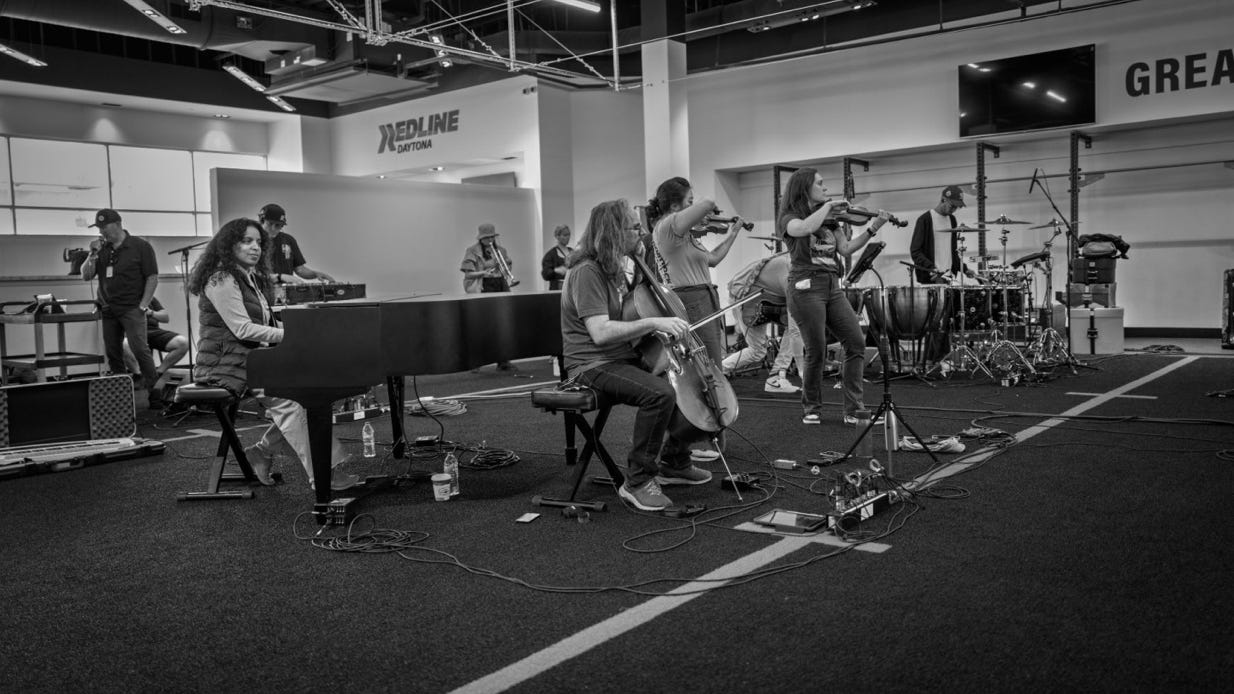
KV: It’s amazing when you see your productions come together. One thing I’m very interested in is how you worked with your music director, Chris Styles, whose amazing, on the Great American Music Collective you put together for the Daytona 500. Can you explain what it is — and how you made it happen?
I had been thinking about how to have a live orchestra as part of driver introductions for awhile. I worked with Chris [Styles] who has amazing relationships from touring as an artist with other live musicians. At Jimmie Johnson’s NASCAR Hall of Fame party, Chris and a team of musicians came and performed and I thought, something is definitely here. So, Chris gathered ten different musicians from all over the world and brought them together. We built a music track that was acoustic songs that you would recognize. We stacked them together and then taught the band how to play them together as one. That is what ultimately turned into the Great American Music Collective. They had never met prior to rehearsal the day before. They had talked on a couple of Zooms and they knew what music they needed to play individually, but we didn’t know how it was going to come together until Saturday in Daytona. We had a rehearsal space and they did it for the first time and it was…magic.
KV: That is so awesome, I love that. So that was the first race of the year, fast forward to the final one. You all had the viral Sydney Sweeney scripted moment at Phoenix on stage. How do those moments come together?
Our entertainment team, led by Kat Lee and Phil Metz had been talking to Sydney’s camp for a long time about doing something. They reached out as part of championship week and wanted to promote her new movie. They didn’t confirm until Friday night, two days before she showed up. Her confirmation was, “she’s going to come. What are you doing with her?” I grabbed our buddy Daryl Motte, and asked him how we integrate her into the Champ Four moment and having her on television, without distracting from the Champ Four and making it stand on its own. She was promoting a movie about being a boxer, [Christy] so that’s where Daryl helped me write a script, which was about the grit and determination it takes to be an elite athlete. We really wrapped it around that movie and what she was portraying in that movie, along with the epic-ness of making it to the Champ Four. We wrote that script, we sent it to her team, they had zero edits, which was incredible. They agreed to it Saturday night. She showed up on Sunday she walked through, knew what she was doing, memorized the lines, delivered it and it ended up turning out pretty decent.
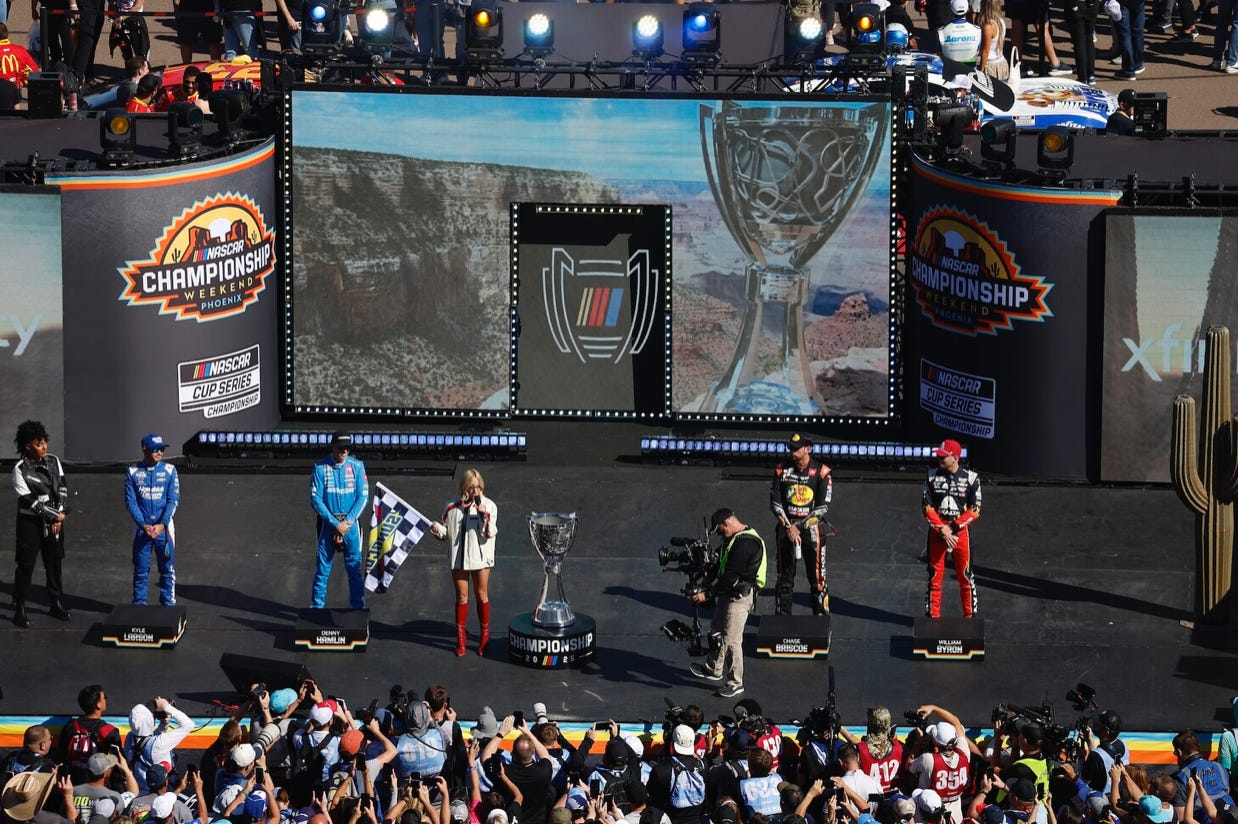
KV: It was amazing! I didn’t even know that was happening and I was like ‘oh wow, Sydney Sweeney is on stage with them…’
Because it came together so fast, I see where our team is excelling. Chris created custom music for the moment, Daryl really polished the script. We went through a proper rehearsal where Sydney knew what she was doing. To pull an actress like that together in 42-78 hours and then nail it…we had a moment where I felt like the team is now gelling fully as a well integrated event team. It felt like it was a well thought out, curated part of a show.
KV: I am stunned to hear that came together that fast. I want to talk about your side passion of photography, it’s a creative outlet but how has it helped you in your job in a new way?
I’ve been doing it now for two years, so it’s new to me. It’s making me think about capturing the image and then how do those images we are creating at NASCAR or at a pre-race experience, how are fans capturing those images for their day? It slows me down a bit. To look around and pay attention. To try and be present in how people are experiencing events. How do we do more grid walks? How do we create more moments where there are these bonding times throughout a race weekend?
KV: Final question would be advice you would give to someone looking to pursue something similar to what you have done with your life work?
I think internships are an amazing opportunity, building a network. I talk to a lot of college classes, and I always tell them, the way you present yourself and the network you create will be with you forever. LinkedIn for example, I’ve been writing on my LinkedIn consistently for so long, that now I have a body of work. So when someone is trying to learn about me, they can go to my website or my LinkedIn and see all my passions I have and what I represent. They don’t have to rely on one information stream. So, students starting that as young as possible is really the key, it just takes time. I started creating some videos for Instagram and LinkedIn at one point, they were really basic it was a “Hey Verlatti’ series where I would answer questions about the latest thing that I bought. I did it because I had time, I owned my own business and I wanted to stay relevant. At the time, I was asking myself, ‘why am I doing this?’ Now, when I go to do an interview on-camera I’m much more comfortable than I ever would have been if I didn’t do that video series. Even if these things don’t make sense at first glance, fast forward 25 years into a career and it has all helped me get to this spot that I’m fortunate to have and feel really privileged to have, but it wouldn’t be possible without putting in those reps.
KV: I totally get that. My first reports were on a green screen I made in my house, I understand the need to tap into a skill on your own. You’re not employed by anybody, you’re just doing it on your own.
It feels so awkward and everyone thinks they’re bad at it, and maybe they are, but the only way you’re going to get good is by getting those reps in. You can’t wait for somebody to pay you to get those reps. By that time, they have already found somebody who has more experience. I go back to, I’m not book smart, but I’m willing to put in the work. For me, that’s always been part of the work.
Special thank you to Michael Verlatti for sharing his story with People Who Race.